
Feng Shui Mirrors

Mirrors can do more than just show your reflection. In Feng Shui, they’re tools that shift the energy of a space either in a good way or a not-so-great one. Used right, they can help bring in more light, create a sense of calm, and even support things like wealth or focus.
This guide breaks down where to put mirrors (and where not to), what types to use, and how to make them work with the flow of your home or office. We’ll cover each room, talk about common mistakes, and show you how to use mirrors without turning your space into a funhouse or messing with your sleep.
Whether you’re just curious or already into Feng Shui, this will give you real tips that work in real spaces.
What Are Feng Shui Mirrors & Why They Matter
Definition & Role in Feng Shui
In Feng Shui, mirrors are more than decor. They’re considered tools that can shift the energy in a space. Think of them as a way to guide, bounce, or even multiply chi—the life energy that moves through your home or office.
Mirrors are linked to the water element in Feng Shui. Water is about flow, reflection, and adaptability. That’s why mirrors are often used to “move” energy in places where it’s stuck, blocked, or bouncing in the wrong direction. A well-placed mirror can help energy circulate better, just like water flowing around rocks in a stream.
That said, it’s not just about putting mirrors anywhere and hoping for the best. Where you place them and what they reflect matters a lot.
Benefits of Using Feng Shui Mirrors
Used correctly, mirrors can do a lot of good in Feng Shui. They can:
- Make a small space feel bigger
- Bounce light into dark corners
- Shift the energy in tight or awkward areas
- Double the positive energy in a room (this is why people talk about mirrors doubling abundance)
One popular example is the stove. In Feng Shui, the stove represents wealth. So if you place a mirror where it reflects the burners, it’s believed to symbolically “double” your income potential. Mirrors can also be used to create a stronger sense of balance in rooms that feel off. A carefully placed mirror can calm the energy, add depth, or correct something that’s missing from the layout.
Common Misconceptions
You’ve probably heard some strict rules—like never put a mirror facing a door. The truth is, it depends on the Feng Shui approach.
In Classical Feng Shui, mirrors facing the front door are usually avoided. The idea is that a mirror directly across from the entry pushes beneficial chi right back out.
In real life, though, especially in small or tight spaces, some people place mirrors near entrances to make the space feel bigger. While this might help visually, it’s not recommended if it causes energy to bounce out or reflect clutter.
Same goes for bedrooms. Some people say mirrors in the bedroom are always bad. In Classical Feng Shui, the real issue is what the mirror reflects and how it affects sleep or relationships. We’ll get into that more below.
Top Mirror Placement Rules Room-by-Room
You’ve probably seen a lot of “rules” online about where to hang mirrors in Feng Shui. Some of them are helpful. Some just repeat the same stuff without context. This section breaks it down room by room, so you can see what actually works—and what to avoid.
Entryway & Front Door
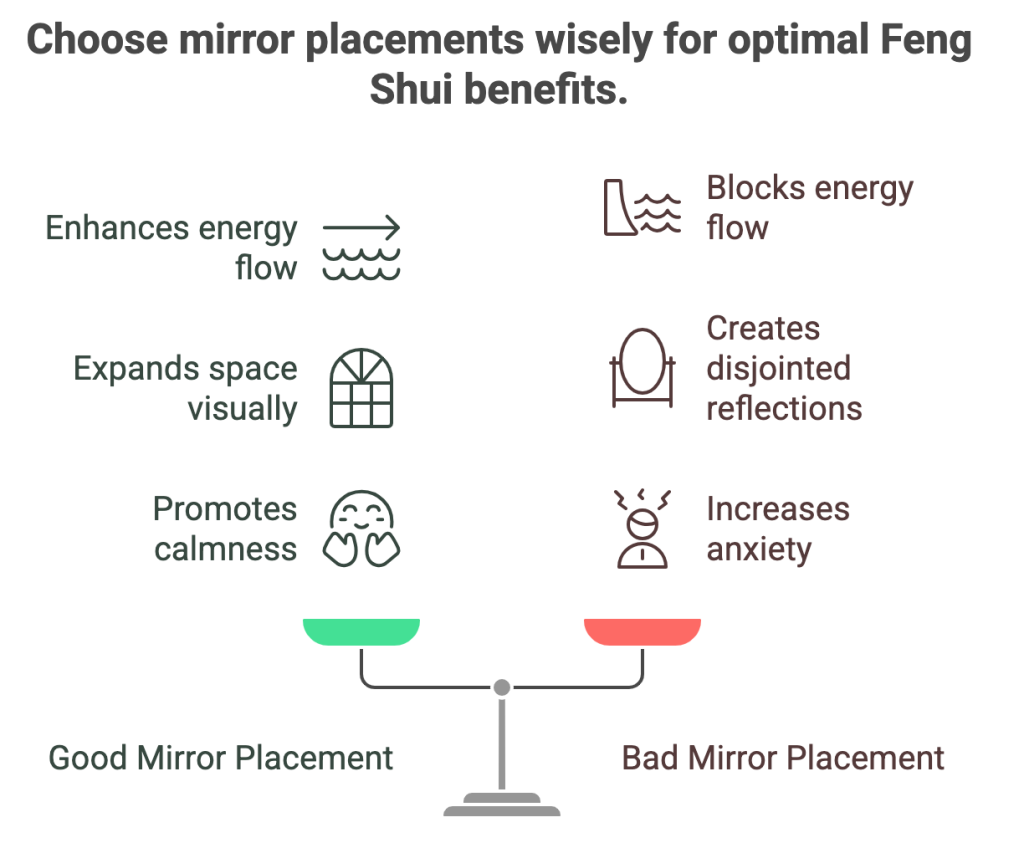
Avoid placing a mirror directly opposite the front door. It’s believed to push good energy (chi) out before it has a chance to enter and circulate through the home.
A better option? Place the mirror to the side of the door, so it expands the space visually without sending energy back out. This supports better flow and allows energy to settle in.
Living & Dining Rooms
These are great spaces to use mirrors—if you’re careful.
- In the dining room, a mirror can “double” abundance by reflecting food or people around the table. It’s considered good for wealth and relationships.
- In the living room, mirrors can make the space feel open and welcoming. Just don’t have them reflect mess, sharp edges, or arguments (yes, energy matters here too).
Pro tip: Avoid mirrors that cut off heads or feel disjointed. Feng Shui mirrors should feel whole and balanced.
Kitchen & Stove
This one’s tricky.
- Feng Shui generally does not recommend mirrors in the kitchen—especially near or reflecting the stove.
- The stove represents fire. A mirror is connected to water. Fire and water clash, symbolically. So placing a mirror behind the stove might stir up tension instead of boosting wealth.
That said, some people still use mirrored backsplashes. If you do, just make sure it reflects something neutral or calming—not clutter, flames, or trash bins.
Bedroom
This is one of the most sensitive areas for mirror placement.
- Avoid mirrors that reflect your bed. The thinking is that it can disturb sleep, increase anxiety, or even affect relationships by inviting a third “presence.”
- Same goes for mirrors reflecting the bedroom door—too much movement or energy at night can mess with rest.
- A workaround? If you have mirrored closets, consider sliding panels or cloth covers at night. Or use soft curtains that can be drawn when needed.
Bathroom
Bathrooms already tend to have built-in mirrors—but their placement matters.
- A mirror directly facing the toilet isn’t ideal. It reflects draining energy.
- If you want to boost Feng Shui here, place a mirror outside the bathroom door to push energy away from the space (which is considered a chi drain).
- Keep the bathroom clean and uncluttered. That matters more than anything.
Home Office & Desk
If your desk faces a wall, you’re not in a “command position.” That can feel limiting, especially for focus or career growth.
- A small mirror on your desk or wall can help you see the entrance—a simple Feng Shui fix for command.
- Just make sure the mirror doesn’t reflect your computer screen or clutter.
Hallways & Staircases
- Long, narrow hallways can trap or speed up chi. Mirrors placed along the sidewall can help open things up.
- But don’t put a mirror at the very end of the hallway. It can block energy instead of helping it flow.
- Same with staircases. You can use mirrors to bounce light or widen the feel of the space, but avoid mirrors that “cut” through the stairs or feel visually jarring.
Windows & Views
- If a mirror reflects nature, trees, or open sky, that’s a win. It brings more of that good outdoor energy inside.
- But if it reflects something ugly—like power lines, trash cans, or your neighbor’s wall—you’re doubling down on that instead.
When in doubt, ask yourself: What is this mirror reflecting? Would I want more of that in my space?
Choosing the Right Mirror: Shape, Size, Frame & Material
Picking the right mirror isn’t just about style. In Feng Shui, every part of a mirror—its shape, frame, material, even size—can shift the energy of a room. Here’s how to make smart choices that look good and support the vibe you’re going for.
Mirror Shapes & Element Alignment
Different shapes connect to different elements in Feng Shui. The shape you choose can either boost or clash with the energy in a room.
- Round or oval mirrors represent the metal element. Great for clarity, focus, and clean energy. These work well in offices or bathrooms.
- Square mirrors are tied to the earth element. Think grounding, stability, and balance. Good for bedrooms or dining areas.
- Rectangular mirrors represent wood. Growth, expansion, and creativity. Nice in living rooms or hallways.
- Triangular or pointed shapes connect to fire. High energy and passion—but too much can feel intense. Use sparingly.
Stick with shapes that feel solid and complete. Avoid jagged or oddly shaped mirrors—they can create confusion or fragmented energy.
Frame Materials & Colors
The frame matters more than most people think. It adds its own layer of energy, especially in Feng Shui.
- Wood frames bring in earth energy—warm, grounded, and supportive.
- Metal frames support the metal element—sharp, clear, and clean.
- Black or blue frames can support the water element (which ties into mirrors already).
- Red, orange, or purple frames add fire—good if you need more motivation or movement, but don’t overdo it.
Match the frame to the energy you want in that room. For example, a wooden frame in a bedroom helps with grounding. A metal frame in a workspace helps with clarity and focus.
Mirror Integrity & Quality
This sounds basic, but it’s important: don’t use damaged mirrors. That includes cracked glass, warped reflections, or mirrors made from small pieced-together tiles.
- A clean, smooth mirror gives off clear energy.
- A broken, chipped, or distorted mirror can send mixed signals—or just feel off.
Also, skip mirrors that are too small or hung too high. If you can’t see your full face or body comfortably, it’s not doing its job.
Mirror Size & Proportion
Size and placement matter just as much as the mirror itself.
- A mirror that’s too small can create a sense of limitation or chopped energy.
- A mirror that’s too large can feel overwhelming or chaotic—especially in a small room.
The goal is to balance. A mirror should fit the wall it’s on without dominating or getting lost. And it should reflect something worth amplifying—like light, greenery, or space—not clutter or sharp corners.
Advanced Strategies & School-Specific Views
This part goes beyond the usual mirror placement advice. Not all Feng Shui follows the same rules, and different schools have their own takes on how mirrors should be used. If you’ve ever read two articles and gotten totally different advice, this is probably why.
Classical vs Flying Star Schools
There’s no one-size-fits-all rule in Feng Shui. Different schools teach different things—and that includes how they use mirrors.
- Classical Feng Shui is more rule-based and tied to compass directions and elements. It’s strict about things like not putting mirrors across from the front door or near the stove.
- Flying Star Feng Shui is more advanced and based on time and space. It tracks how energy changes over the years and might recommend moving or removing mirrors based on the current “flying stars” in your home.
So if you’re seeing conflicting advice online, it’s not that someone’s wrong—it’s probably that they’re following a different system.
Bagua Map Integration
This part can be removed entirely, unless you’re planning to integrate the Classical Eight Mansion or Flying Star methods into Bagua-like explanations. Since the Bagua map in BTB Feng Shui is used in a fixed way (unlike Classical methods), it’s best to skip this section unless you’re offering a Classical Bagua interpretation based on compass directions.
Using Mirrors with Flying Star Feng Shui
Flying Star is a more technical method that tracks how energy flows through a home based on its age, compass direction, and the current year.
- Some stars are considered lucky (like Star 8), and others are linked to problems (like Star 5).
- Mirrors can be used to neutralize bad energy or enhance good energy, depending on where those stars land in your house.
- Example: if a negative star lands in your bedroom one year, you might be advised to move a mirror out of that space to avoid amplifying the issue.
You don’t have to use this method, but if you’re working with a Feng Shui consultant, they might bring it up.
Cure Mirrors: Convex, Concave & Ba Gua
Not all mirrors are flat.
- Convex mirrors (they bulge outward) are used to reflect and push away negative energy. You’ll often see them outside homes, facing a sharp corner or a neighbor’s front door.
- Concave mirrors (they curve inward) are said to absorb and transform bad energy, though they’re less common.
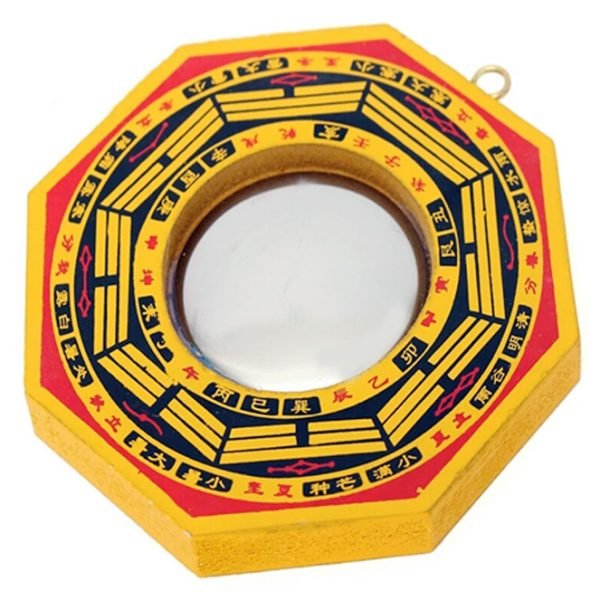
- Ba Gua mirrors are round with an octagonal frame around them, usually with trigram symbols. These are used only outside to protect the home—not inside.
Important: These mirrors aren’t for decoration. They’re specific tools with a job to do. Don’t hang one indoors unless you really know what you’re doing—or you could stir up more issues than you fix.
Troubleshooting Common Pain Points
Sometimes mirrors cause more stress than harmony—and a lot of it comes from small mistakes people don’t realize they’re making. Here’s how to spot and fix the most common mirror-related issues in Feng Shui.
Mirror Facing the Door Ruins Luck?
This one comes up a lot. You’ll hear that a mirror facing your front door will bounce good luck right back out of your house.
In Classical Feng Shui, a mirror directly opposite the front door is generally a no-go. It’s believed to reflect incoming chi straight back outside.
That said, in smaller homes or apartments, some people do place mirrors near the entrance for visual expansion. If you do this, just be careful about what’s being reflected. If it’s clutter, shoes, or a chaotic hallway, that energy is being magnified.
Bottom line: if the mirror feels off, trust your instincts and move it. The energy in a space should feel settled, not jumpy.
Clutter Reflection
What your mirror reflects matters. A clean room gets amplified as clean energy. A cluttered area? Same story.
If your mirror reflects:
- a messy counter
- a trash bin
- tangled cables
- or that pile of laundry you meant to fold three days ago…
…it’s not helping your space.
Quick fix: Declutter what’s in view. Or turn the mirror slightly so it reflects light, plants, or something calming instead.
Bedroom Sleep Disturbances
Some people sleep fine with mirrors in the bedroom. Others say it makes them restless, or even anxious.
Here’s the Feng Shui take:
- Mirrors that reflect the bed can feel intrusive. It’s like someone’s watching you—or like the energy is still “awake” even when you’re not.
- Mirrors that reflect doors or busy parts of the house can also disrupt rest.
Simple fix: Cover the mirror at night with a fabric or curtain. If it’s a closet mirror, consider sliding panels or frosted film. See how you sleep after that. If it feels better, you’ve got your answer.
Too Much Light or Heat Glare
Sometimes mirrors bounce more than energy—they bounce sunlight, heat, or even noise.
- A mirror that catches afternoon sun can overheat a room or create harsh glare.
- At night, it might reflect artificial light that makes it hard to relax.
If that’s happening:
- Shift the angle of the mirror slightly.
- Use curtains or blinds to soften harsh light.
- Or consider using a non-reflective material in that spot instead (like artwork or wood).
Feng Shui is all about how a space feels to live in. If something’s irritating, that’s reason enough to change it.
FAQ: Common Questions About Feng Shui Mirrors
These are the kinds of questions people ask all the time—online, in forums, or when they’re trying to fix something that feels “off.” Short answers, clear advice.
What mirror shape is best for wealth?
Round or oval mirrors are great for attracting wealth. They’re tied to the metal element, which supports clarity and focus—key traits for financial success in Feng Shui. That said, it also depends on where you place it. In the wealth corner (far back left when standing at your front door), it can amplify abundance if it’s reflecting something positive, like a plant or art.
Can mirroring the stove boost finances?
It can—but only in some situations. In Feng Shui, the stove represents money and nourishment. Placing a mirror behind or beside it to reflect the burners is said to “double” your wealth. Just watch for the fire–water clash (mirrors = water). If the space already feels tense, this might not be worth the risk. You could use polished metal or a reflective backsplash as a softer workaround.
Is it OK to have a mirrored kitchen backsplash?
It’s not ideal in Classical Feng Shui—again, because of that fire–water clash. But if your mirrored backsplash reflects something positive (like light, not trash), and your kitchen feels calm and functional, it may not be a big issue. Just avoid anything that reflects clutter, knives, or mess.
How high should a mirror hang?
Eye level is a good rule of thumb. You want to see your whole face without tilting your head. In Feng Shui terms, a mirror should feel grounding, not like it’s floating too high or slicing through your head or body. Don’t hang it too low or too high—go for balance.
Can a mirror reflect bad luck?
A mirror doesn’t create bad luck, but it can reflect and multiply whatever energy is already in the space. If it’s reflecting clutter, chaos, or sharp angles, that energy gets bounced around. On the flip side, if it reflects something peaceful or prosperous, that’s what it enhances. It’s all about what the mirror is “showing” back into the room.
Should I cover bedroom mirrors at night?
If you’re waking up tired, feeling unsettled, or just not sleeping well—and you have a mirror in your room—yes, try covering it. A lot of people report sleeping better when they do. Use a curtain, fabric panel, or folding screen if you don’t want to remove it completely.